
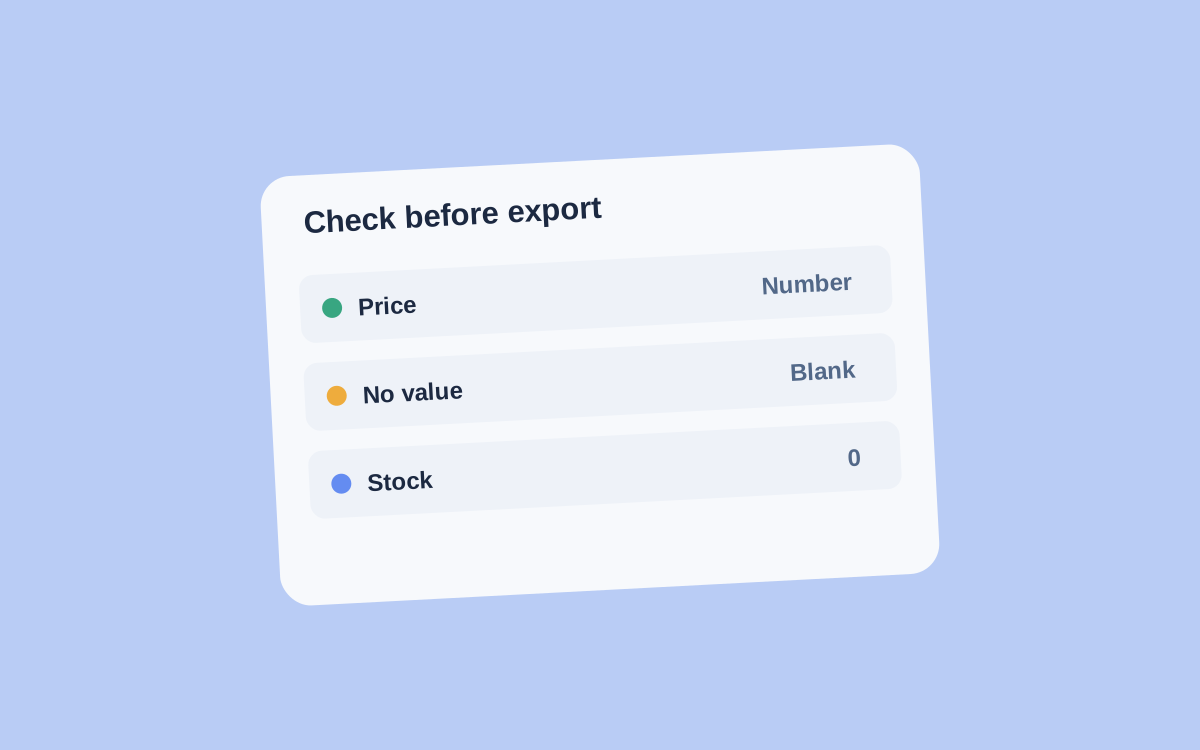
A file opens, its rows are present, and its record count looks plausible. That does not yet make it ready for another system. One wrong required field may matter more than hundreds of correctly collected cards.
Check a small, understandable sample, then apply the same rules to the full result. Include a typical product, one without a price, a variant with several images, and a record with a long name.
An empty cell is not zero
If a price was not obtained, do not insert zero just to fill the column. Zero is a specific value that may affect the recipient's calculations. A missing price says that the value was unknown in this run.
The same applies to stock. An empty field does not prove that the warehouse has no items. A different page variant, changed markup, or extraction error may be responsible. Find the cause before deciding how to deliver the result.
In Akmelo's export mapping, a missing value can become null, an omitted field, or a default value. Agree on the rule with the recipient. In a fixed-column CSV, both null and an omission leave a cell empty; there is no missing field as there can be in JSON.
Check keys and types
Each record needs a clear identity. A product variant usually needs more than a name; the key might combine SKU and size. If different variants receive the same key, row count alone says little about quality.
Then check types: prices should use an agreed numeric format, dates the expected format, and availability a value the recipient understands. Do not turn an SKU into a number if it can start with zeroes. See the catalog field guide for a useful starting set.
Look from the recipient's side
Open a sample from the saved Akmelo export. Check field names, nesting, missing values, and several real records. Then try a sample file in the intended receiving system. A preview does not test that system's import rules.
Compare source and output record counts. A difference may be expected when filters apply. Otherwise, explain it before regular delivery. If the recipient cannot read the file structure, review CSV, JSON, and XML selection. Agree on field meaning and missing-value handling separately.